Research Highlights

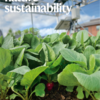
A cover from the journal Nature Sustainability Volume 8 Issue 8. The cover shows red radishes emerging from the soil, their vibrant green leafy tops healthy and full. In the background, a metal frame holds solar panels above the plants, and a weather station stands to the side, showing a combination of sustainable agriculture and renewable energy monitoring.

Optimizing multi-use solar landscapes

An article was published by Caroline Merheb, Dr. Sujith Ravi and Dr. Nick Davatses of the Department of Earth and Environmental Science at Temple and their colleague Jordan Macknick of the U.S. Department of Energy in the journal Nature Sustainability.  The article, “Synergies and trade-offs of multi-use solar landscapes” synthesizes data on efforts to combine solar energy with agriculture (agrivoltaics) or natural vegetation (ecovoltaics). It provides guidance in optimizing multi-use systems through the consideration of local economic impacts, ecosystem services and stakeholder perspectives in design and implementation. The cover image for the journal’s July 2025 issue features the team’s research at the Temple Ambler Field Station. The research was further described in a Temple University news story that included a conversation with the authors.
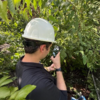
A person wearing a white hard hat kneels on the forest floor, surrounded by dense foliage. They are using their phone to take a photograph of a plant for identification.

Tracking Spotted Lanternfly impacts on forest trees

A newly invasive insect pest known as the spotted lanternfly (Lycorma delicatula) poses an important, emerging threat to forest habitats in Pennsylvania. The spotted lanternfly (SLF) is a planthopper native to northern China but was recorded for the first time in the Americas in Berks County, southeastern Pennsylvania, in 2014, suggesting a recent human-mediated introduction.  Since then, it has spread across much of Pennsylvania and neighboring states.  The SLF is of particular concern as it has the potential to cause harm to a wide variety of tree, shrub and vine species, but much remains unknown about these potential impacts.  Drs. Brent Sewall (Associate Professor of Biology at Temple University and Director of the Temple Ambler Field Station) and Amy Freestone (Senior Scientist at the Smithsonian Environmental Research Center) are leading a team of researchers and students to explore impacts of the spotted lanternfly on some of Pennsylvania's native plants. This research involves SLF trapping and rearing experiments and mesocosm studies at the Field Station.  This research is funded by the Pennsylvania Department of Military and Veterans Affairs (DMVA). The research will inform the management of DMVA properties across the state, including Fort Indiantown Gap National Guard Training Center.

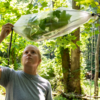
A person stands in a lush green forest as sunlight filters through the canopy, illuminating the leaves with a bright green glow. They look up at a tree branch enclosed in a clear plastic bag, carefully examining it. Water droplets have collected at the bottom of the bag, noticeable as the sun shines through.

Turning Temple students into community scientists

Dr. Mariana Bonfim (Assistant Professor in the Department of Biology at Temple University and Managing Director of the Temple Ambler Field Station) and students in her Ecology of Invasive Species course, hosted at the Temple Ambler Field Station, published anarticle, “Mapping change: Temple students lead the way in invasive species tracking with iMapInvasives” in the Pennsylvania iMapInvasives Program Newsletter. In the article, the team, which includes student authors Gabriela Cano, Grace Hodges, Keri Kern and Ian Stonefield, highlights how they have taken science beyond the classroom and have merged participatory science with immersive fieldwork to detect, track and record the spread of invasive species locally, while linking their work to larger regional and global efforts. The course uses modern technological tools and field studies to enrich student training, advance scientific understanding and inform regional plans for the management of invasive species.