
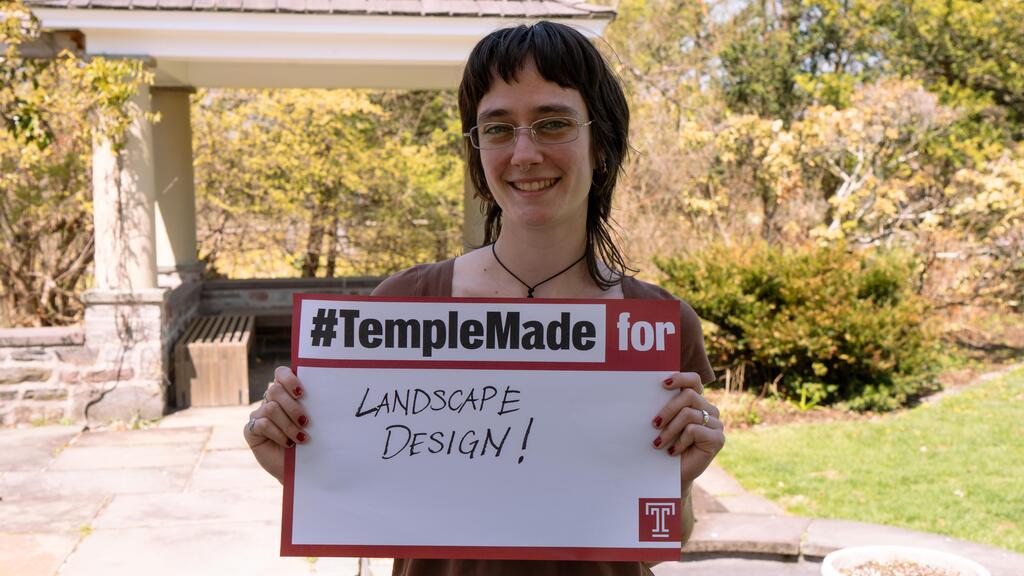
Esther Joy Landis, a recent graduate of Temple’s Landscape Architecture program, offered by the Tyler School of Art and Architecture, has a clear vision of the types of projects she’d like to work on in her career.
“As a landscape architect, I really like the idea of working directly with people. There are some very cool, very large projects that happen and I love that there are people that have a passion for working at that scale, but I’m much more focused on working one-on-one with someone, designing their backyard, or working on public parks and other work that benefits the general public,” she said. “I want to focus on smaller scale human-to-human design. For me personally, it’s not about these huge concept designs; it’s more about making a positive impact for a person or a community.”
Landis arrived at Landscape Architecture by taking the scenic route.
“I started at Temple as a secondary education English major. I love books and I love English as a hobby, but after the second year, I found I wanted to do something that was more tangible — something where I was learning hard skills rather than interpretation,” she said. “I was exploring my options and discovered landscape architecture. I really didn’t know what it was before then, but it seemed like this perfect combination of creativity, science, math, hands-on learning — the best of all worlds related to the things that I enjoy doing. It certainly worked out for me.”
While at Temple, Landis was part of the team that created Temple’s 2025 multiple award-winning Pennsylvania Horticultural Society Philadelphia Flower Show exhibit, Reflections on Regeneration: An Artful Response to Our Changing Environment.
The exhibit won several top honors, including a PHS Gold Medal, awarded to a major exhibit that receives 90 to 100 points in the “criteria of design, horticulture, plantsmanship and educational value,” the Bulkley Medal of the Garden Club of America for a special exhibit in the field of horticulture, botany, or conservation “that best combines an important message with the ability to convey that message to the public,” and the Alfred M. Campbell Memorial Trophy, given to the “educational major exhibit that demonstrates the most successful use of a variety of plants in a unique fashion.”
“Our experience with the Philadelphia Flower Show is one of the most unique aspects of the Landscape Architecture program. By its nature, it’s one of the most comprehensive project we are involved with,” Landis said. “Unlike some of the other pen and paper projects, we’re actually getting to build something — how much all this costs, how many two-by-fours you need, how every aspect of the exhibit will piece together. It really makes you think about things in a different way, specially from a design perspective; something that seems great in your head might be impossible to build in the real world so you have to work together to figure that out.”
Just a few weeks prior to graduation, Landis began work at Bates Landscaping “on the design and project management side of things.”
Learn more by viewing the video.