
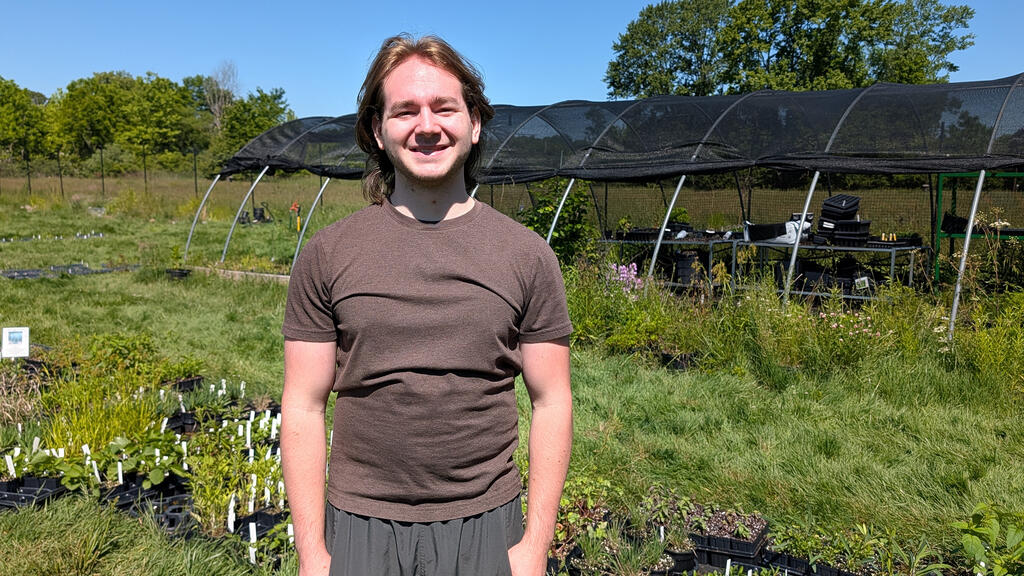
Jarett Figlin first learned about Temple University Ambler from a very reliable source.
“My mom went here in the 1990’s. When I was applying to school and figuring out where I wanted to go, we took a tour of the Ambler Campus and I was immediately drawn to it — I love the natural spaces here and the community that was so welcoming to us,” he said. “When I got into Temple and the time came when I needed to make a decision about which campus I wanted to go to, I knew this was the place that I wanted to be.”
Figlin recently graduated with a degree in Psychology from the Temple College of Liberal Arts. Through a combination of in-person and online courses, he was able to complete his degree at Temple Ambler.
“The idea of what goes on in your mind was always of interest to me. I think that I have an empathy for people who are going through certain very difficult mental situations, and I want to use that to help people that may not be able to help themselves,” he said. “In my sophomore year of high school, I took an introductory psychology class that further sparked that interest.”
According to Figlin, his first three years at Temple “were almost entirely at (Temple Ambler), which was extremely beneficial for me.”
“The professors were very engaged with us. I really got to know the other students on a deep level,” he said. “It was beneficial as a Psychology student to get that intimate experience with each other.”
While dedicated to completing his degree, it was in the Ambler Arboretum community where Figlin truly found a home, working several seasons as a student gardener and staying on in summer 2026 as an intern in the Collins Nursery of the Ambler Arboretum — all the while incorporating what he was learning in the gardens with his career goals and his approach to psychology.
“I had no knowledge of natural sciences and plants. Honestly, I really started to explore (the opportunities) because I needed a job,” he said. “I got an email from the director of the Arboretum, Kathy Salisbury, that said they were hiring student workers. I decided I might as well give it a shot. I remember I texted my mom about it and she was like ‘You don’t have any knowledge of plants or anything like that,’ but fortunately I got an interview and got accepted — I’m so grateful for the experience it gave me.”
There’s an interconnectedness between plants “with every discipline and with all of us as people,” Figlin said.
“You don’t just have to be a Horticulture major or Landscape Architecture major to get something out of it. It’s a part of understanding yourself and grounding yourself in the world around you,” he said. “I’m grateful to have taken that wild leap and applied for a job that is very outside of my wheelhouse.”
Working within the Arboretum provided a great deal of experience taking care of trees and native plants, Figlin said.
“It was a really interesting job for me compared to some of the other jobs I worked in the past. We have a really interconnected, welcoming community that I still refer to as part of my family,” he said. “We all have this common goal of taking care of these plants, reconnecting with the natural world and giving people a place to feel welcome and respected. We planted many of the trees that were planted after the (2021) tornado — that the was the bulk of my job for the first couple of years I was here.”
The Arboretum community, Figlin said, “does a lot not only to take care of the campus and the plants but to foster a community here, which is really meaningful to me.”
“Every week we have volunteer sessions, which changes a little with the seasons. We encourage lots of volunteers to come out from the community,” he said. “As a psychology major, working with people who are from many different backgrounds with potentially a lot of different reasons that brought them to the gardens, I’ve found that’s it’s been a very beneficial aspect of working here. For me, I have the opportunity to engage with all of these people and make them feel welcome in something that they might not necessarily feel comfortable with — we get a lot of volunteers that come in that don’t really know a lot about plants; they want to try something new.”
Helping volunteers not only learn about plants, “but what plants mean for them and how they can find this sense of community and bolster their wellbeing has been a really beneficial part of working here and surprisingly very applicable to being a Psychology major,” Figlin said.
Figlin’s dedication to the Arboretum and the Ambler Campus hasn’t gone unnoticed. He was presented with a Growing Wonder Award, given to an Arboretum Student Gardener “who exhibits curiosity about the art and science of horticulture and the natural world around them and takes the initiative to learn more on their own and share the information they have found with the Arboretum Community;” and a Golden Owl Award, given to graduating seniors “who have displayed outstanding leadership and dedication to the Temple Ambler Campus community through their participation in on-campus activities, organizations and community efforts.”
“Working for the Arboretum, Jarrett has become an indispensable part of our team. He regularly works with our volunteers, creating long-lasting connections with the community,” according to the Growing Wonder Award Nomination from the Ambler Arboretum staff. “We are thrilled Jarett went outside of the Psychology classrooms and joined us in the gardens. As he learned more about the gardens, he became a consistent and enthusiastic advocate for the Ambler Campus and the Ambler Arboretum.”
Having entered graduate school to continue to pursue a career in counseling psychology, “I’m writing a literature review on a counseling psychology topic of my choice,” said Figlin.
“Me from a couple of years ago would be baffled at the fact that I’m doing it on horticultural therapy. That is something that I’ve found that has been very tangible and important to my degree and what I want to do in counseling psychology,” he said. “There’s been an interesting mesh there where I was in a very interesting place in my life when I started here. The community that I found here as well as the interest in horticulture and the relationship with the plants helped me on my own psychological journey in a way that I feel could also be replicated for other people.”
Horticultural therapy and knowledge of the natural world “as a tangible, integral part of the human experience rather than something that is separate is a really important part of the positive psychology that I’ll try to impart on my clients going forward,” said Figlin.
“The person that I was before and after I started working here is honestly night and day. I was in such a dark place in my life before I started here and this has been a significant part of growing into the person that I’ve become and who I’m very proud of being,” he said. “Receiving those awards and being recognized as someone they’ve welcomed into this Ambler family, being appreciated for not only the work I’ve done here but they way I’ve interacted with people, was really meaningful to me to highlight that difference from where I started and where I’ve ended. It was a great way to cap off my degree and show what I’ve gained from college beyond the academics.”
Temple, Figlin said, is fundamentally “a place for people to come and find themselves and find the community that’s welcoming to them.”
“So much of that can be done at Main Campus, but so much of that can and has been done (at Temple Ambler). You go around the Ambler Campus and you ask anyone who is walking around, they are always going to be happy to talk to you because it’s the friendliest people you’ll ever meet,” he said. “They’re always going to say how much this campus means to them and how they found so many unique things here. I know from my own experience, this campus played a really significant role in changing and helping my life. I think it’s an integral part of what Temple is and what Temple means to students as a place to find themselves and find other people.”
Learn more about the Ambler Arboretum of Temple University at https://arboretum.temple.edu.
Learn more about the Temple College of Liberal Arts at https://liberalarts.temple.edu/.